Progress Over Perfection: The Myth of Motivation
Motivation comes and goes with mood, sleep and circumstance. A plan that only works on good days will fail on the ordinary ones.
It is eleven at night and the gym bag is still sitting by the door, zipped shut, exactly where it was this morning. This is the third week running. Nothing dramatic happened — no injury, no crisis, just the ordinary erosion of a plan by a Tuesday. Most people reach for an explanation here: not enough willpower, not enough discipline, not built for this kind of thing. The explanation is wrong, and it is wrong in a way that keeps people stuck.
Willpower is a poor foundation for a life. Motivation comes and goes with mood, sleep and circumstance, and a plan that only works on good days will fail on the ordinary ones. Building a goal on top of it is like building a house on sand that happens to be dry today. The people who change something lasting rarely rely on wanting it badly enough every day. They build things so the behavior keeps happening on the days the wanting fades.
Twenty-one days is a myth someone made up
The number everyone quotes — twenty-one days to form a habit — traces back to Maxwell Maltz, a plastic surgeon who noticed in the 1950s that patients took about three weeks to get used to a new appearance, and that amputees felt a phantom limb for about as long. In his 1960 book Psycho-Cybernetics he wrote that it takes "a minimum of about 21 days" for a new mental image to settle. It was his own observation, not a study, and he said minimum. Self-help authors repeated it for decades and dropped that word, until it sounded like a scientific rule (Clear, n.d.).
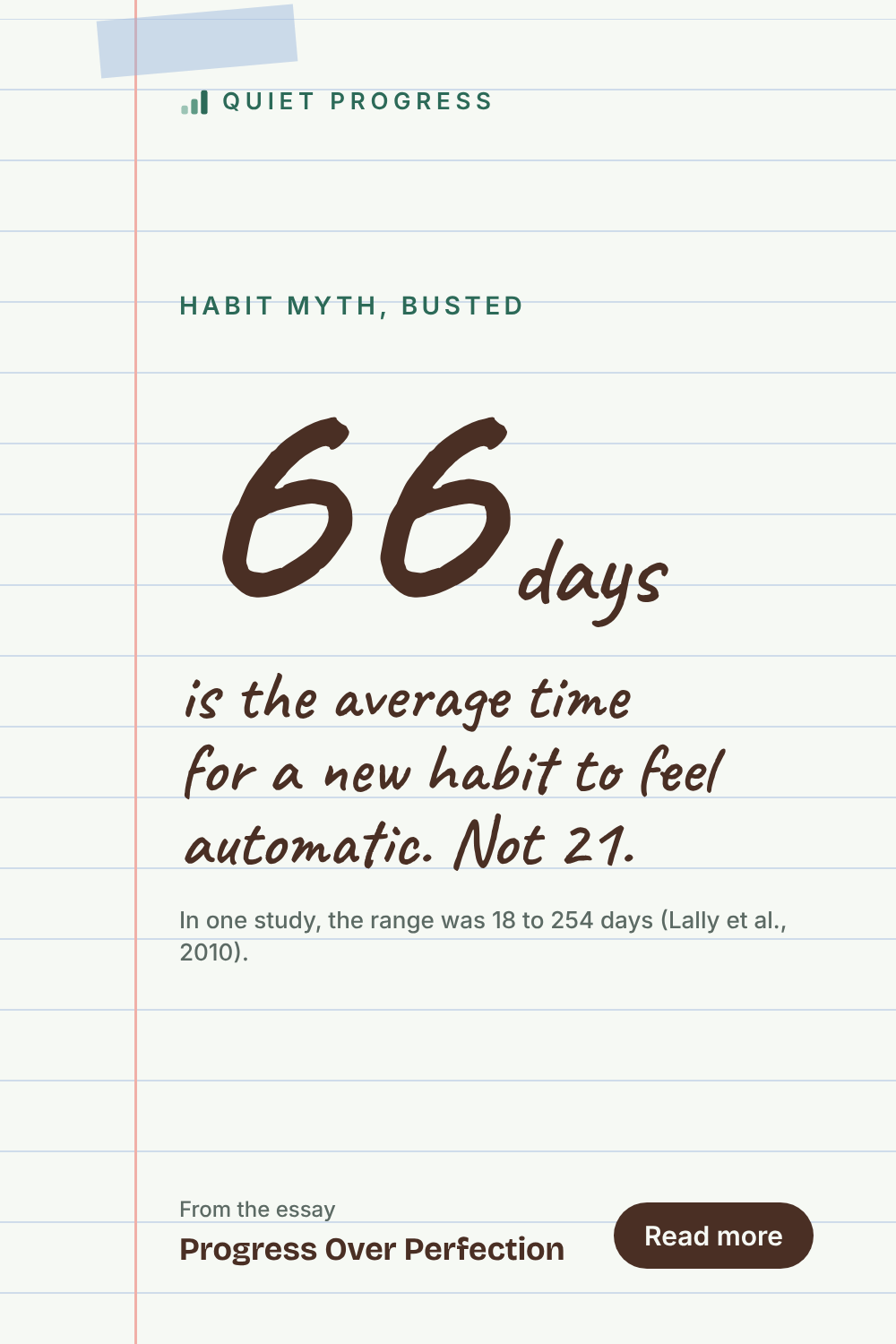
The real research tells a slower, more forgiving story. In 2010, researchers at University College London tracked ninety-six people trying to build a habit of their choosing — a piece of fruit with lunch, a fifteen-minute run — and measured how automatic the behavior became over twelve weeks. The average time before the habit stopped requiring conscious effort was sixty-six days. Not three weeks. And the range was enormous: some people got there in eighteen days, others took two hundred and fifty-four (Lally et al., 2010). One missed day, the data showed, did not meaningfully set anyone back.
That detail matters more than the headline number. Most people quit not because the habit failed, but because they believed one skipped morning had ruined the streak. It hadn't. The thread survives a dropped stitch. It does not survive putting the needle down for good.
Systems outlast goals
Goals tell you where you want to go. Systems decide whether you get there. "Write a book" is a goal. "Write 300 words before checking my phone" is a system.
Picture two students who both want to pass an exam. The first has only the dream: "I will pass." Then a bad week hits. He's sick, tired and discouraged, and he studies nothing. The second has a routine: every day after dinner, she opens her book for twenty minutes. The same bad week hits. She's just as tired, but she opens the book anyway, because that's simply what happens after dinner. She studies less, but she doesn't stop.
On good days, the two look the same. On bad days, only one keeps going. A goal gives you direction. A routine keeps you moving once the motivation is gone.
James Clear makes this point in Atomic Habits. Get 1% better every day and, after a year, you're about 38 times better. Get 1% worse every day and you've nearly vanished (Clear, 2018). The math is simple. The hard part is doing something tiny on a day when it feels like it doesn't matter.
Don't wait to feel ready
There is a saying from the Zen tradition: before enlightenment, chop wood and carry water; after enlightenment, chop wood and carry water. The meaning is simple. Even after a big breakthrough, daily life is still ordinary work, so there is no moment when it suddenly feels different. If you wait until you feel motivated, inspired or ready, you may wait forever. The wood still needs chopping.
Marcus Aurelius was a Roman emperor who wrote private notes to himself. In one, he left himself this reminder: You could leave life right now. Let that determine what you do and say and think. It sounds grim, but its purpose is practical. There may never be a better day to begin, so use the one you have.
Make the habit smaller than your resistance to it
BJ Fogg, a behavior researcher, argues that, for many people, the habits which last start almost comically small, tied to something a person already does (Fogg, 2019). Floss one tooth. Do two push-ups. Write one sentence. The point is never the one tooth. The point is that showing up becomes so low-stakes that skipping it feels stranger than doing it.
Three anchors worth borrowing, if any of this is going to outlive this article:
Attach the new habit to something already automatic — after the coffee, before the shower, right after sitting at the desk.
Shrink it until it feels almost insultingly easy. Insulting is fine. Abandoned is not.
Judge the week by how many days you showed up, not by how good any single day felt.
None of this requires becoming a different kind of person. It requires lowering the cost of showing up until showing up stops being a decision at all.
What this actually adds up to
The gym bag by the door is not a verdict on your character. It's a planning problem: the plan assumed an energetic evening, and a real Tuesday evening is tired. Make starting a little easier, with your shoes by the door and your clothes already out, and you're more likely to do it.
Annie Dillard wrote that how we spend our days is, of course, how we spend our lives (Dillard, 1989). Habits take about two months to feel automatic on average, though it can be much faster or slower (Lally et al., 2010). Keep the task small enough to do on tired nights, and something that feels hard tonight can become something you just do. It won't be because the motivation arrived. It will be because the bar was low enough to clear without it.
Want to come back to this later? Save it to your Pinterest board.
Save to PinterestReferences
- Clear, J. (n.d.). How long does it actually take to form a new habit? James Clear.
- Clear, J. (2018). Atomic habits: An easy & proven way to build good habits & break bad ones. Avery.
- Dillard, A. (1989). The writing life. Harper & Row. Line quoted at The Marginalian.
- Fogg, B. J. (2019). Tiny habits: The small changes that change everything. Ebury Publishing (UK edition).
- Lally, P., van Jaarsveld, C. H. M., Potts, H. W. W., & Wardle, J. (2010). How are habits formed: Modelling habit formation in the real world. European Journal of Social Psychology, 40(6), 998–1009. https://doi.org/10.1002/ejsp.674