The Daily Page: Why Writing by Hand Can Sharpen Your Thinking and Quiet Your Mind
Twenty minutes with a pen each day is one of the cheapest ways to think more clearly, settle a busy mind, and make new knowledge stick.
Most of us spend our days tapping, swiping and typing. Words come fast, and they leave just as fast. Handwriting asks for something different. It is slow on purpose. Each letter has to be formed, each sentence has to wait for the hand to catch up, and in that waiting, the mind starts to sort itself out.
This is not nostalgia for fountain pens. It is a practical habit with real research behind it, and it fits into almost any day. Below is why it works, and a simple way to build it into your life.
What happens in your brain when you write by hand
Writing by hand lights up far more of the brain's networks than typing does. In a 2024 study at the Norwegian University of Science and Technology, researchers fitted 36 university students with 256-sensor EEG caps and had them either write or type the same words (Frontiers, 2024).
When the students wrote by hand, connections between brain regions tied to movement, vision and memory grew much richer. When they typed, those patterns stayed sparse. The researchers link this kind of widespread connectivity to memory formation and learning.
The reason is the body. Typing is one small up-and-down motion repeated for every key. Handwriting is a precise, ever-changing movement that you watch and steer as you go. Your hand, eyes and attention all work together, and the brain has to coordinate them.
A fair caveat: the study measured brain activity, not test scores, and some researchers say the link to better learning is still being worked out. Typing is also better for long drafts. But for thinking, remembering and slowing down, the pen has a real edge.
Writing to quiet the mind
Putting your thoughts on paper turns a swirl of worries into something you can see, name and set down. Psychologist James Pennebaker began studying this in the 1980s, and well over a hundred experiments since have found benefits from writing honestly about what weighs on you (Psychology Today).
In his classic method, people wrote without stopping for about 15 minutes a day, four days in a row. They reported better mood and fewer visits to the doctor. The key seems to be writing both what happened and how you felt about it. That turns a messy experience into a story you can understand, and a story you understand is easier to let go.
There is a quieter benefit too. A slow pen pulls your attention into the present: the scratch of the nib, the shape of each letter, the line moving across the page. For a few minutes, there is nothing to scroll and nothing to answer. It works a lot like meditation, except you end up with a page of your own thoughts.
You do not need a crisis to begin. Research by Laura King found that writing about your hopes and future goals can also make people happier.
Writing to learn
Because handwriting is slow, it forces you to choose what matters, and choosing is where learning happens. When you type, it is easy to copy word for word without thinking. With a pen, you cannot keep up, so you have to listen, compress and put ideas in your own words.
A few ways to use this:
After a chapter or article, close it and write five sentences on what it said. What you cannot recall shows you what to reread.
Write a short explanation of a new idea as if teaching a friend. Gaps in understanding show up fast on paper.
Writing letters and words by hand builds the link between seeing a shape and making it. This is especially useful for scripts with unfamiliar letters, such as Thai, Arabic or Chinese.
For code, math or any tricky logic, sketching steps and arrows on paper often unlocks what staring at a screen does not.
Copy out lines that strike you from books, with a note on why they matter. Over time it becomes a map of your own thinking.
A simple 20-minute daily routine
Pick one notebook, one pen you enjoy using, and one fixed time, then rotate through three modes as your day calls for.
| Mode | When to use it | What to do | Time |
|---|---|---|---|
| Clear the mind | Stressed, restless, or at the end of a long day | Write without stopping about whatever is on your mind. No editing, no rereading. | 10–15 min |
| Think it through | Facing a decision, idea or problem | Write the question at the top, then list options, fears and what you actually want. End with one next step. | 10–15 min |
| Learn something | After reading, studying or practicing a skill | Summarize from memory, explain a concept, or practice writing new words. | 10–20 min |
A good default for each session:
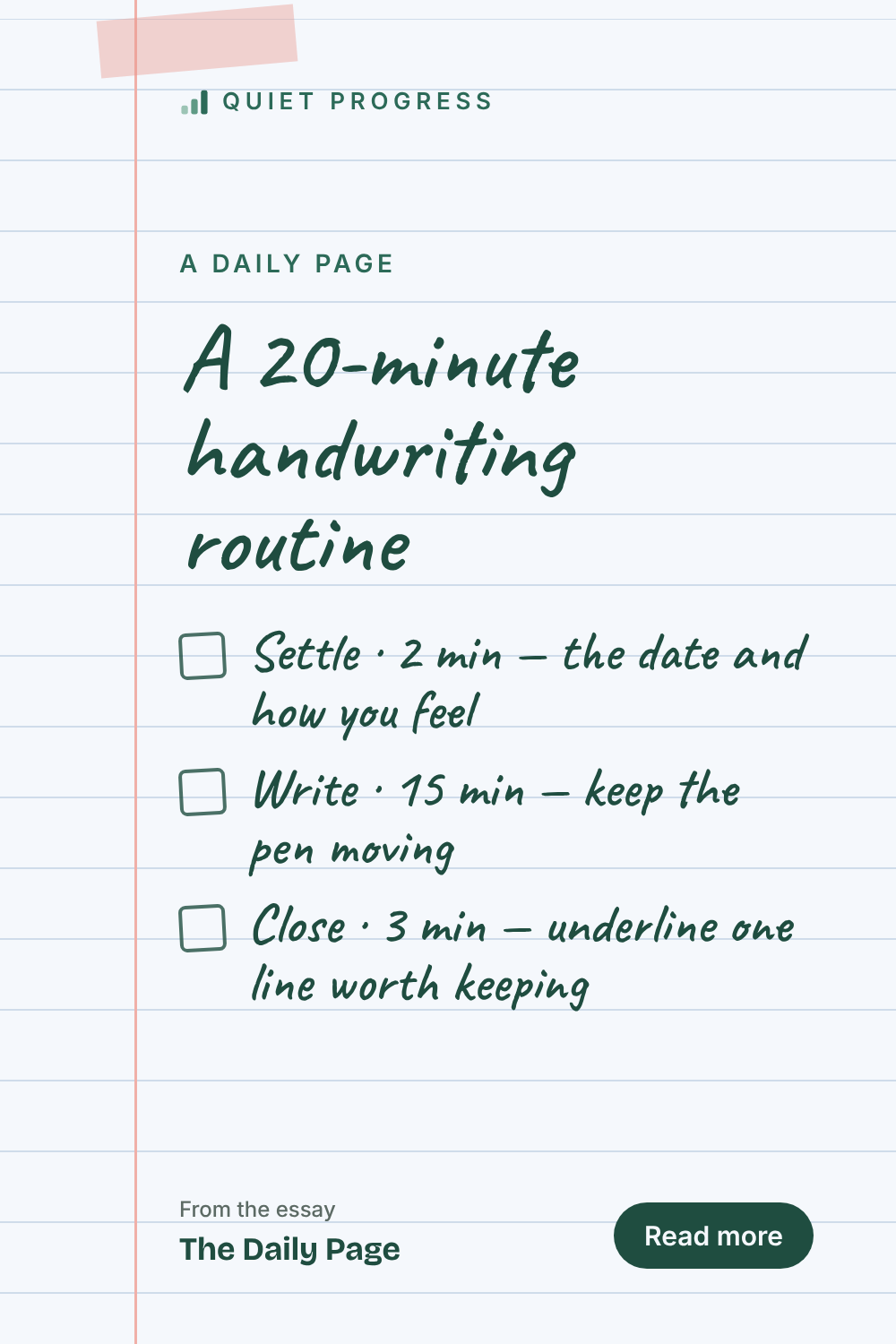
Write the date and one line on how you feel right now.
Choose a mode and keep the pen moving. Slow, readable handwriting is fine; neatness is not the goal.
Underline one sentence worth keeping, and write one thing you will do or remember tomorrow.
How to keep the habit going
The habit lasts when it is small, attached to something you already do, and forgiving of missed days.
- Anchor it. Write right after something you do daily anyway: morning tea, finishing work, or before your evening reading.
- Start smaller than you think. On busy days, one page or five minutes still counts. The streak matters more than the length.
- Keep the notebook visible. Leave it open on your desk with the pen on top. If you have to look for it, you will skip it.
- Write for no one. This page is not a performance. Bad handwriting, half-sentences and crossed-out words are all welcome.
- Reread once a month. Flip back through old pages. Seeing how your worries faded and your ideas grew is the best reason to keep going.
- Miss a day, not two. Life gets in the way. Just make sure one skipped day does not become a skipped week.
The page is waiting
You do not need special pens, perfect handwriting or anything profound to say. You only need to show up for a few minutes and let the hand lead. Some days the page will hold a breakthrough; most days it will just hold you, a little calmer and a little clearer than before. Both are worth it.
Tonight, open a notebook, write the date, and begin with one honest sentence.
Want to come back to this later? Save it to your Pinterest board.
Save to PinterestReferences
- Writing by hand may increase brain connectivity more than typing on a keyboard, Frontiers, January 2024
- Handwriting activates broader brain networks than typing, study shows, PsyPost, December 2024
- The power of the pen, Psychology Today
- Emotional and physical health benefits of expressive writing, Advances in Psychiatric Treatment, 2005